 2026, Vol. 46


金钗石斛(Dendrobium nobile Lindl.)是兰科(Orchidaceae)石斛属(Dendrobium Sw.)多年生附生草本植物,具有较高的药用价值[1]。金钗石斛在贵州主产于赤水市,主要采取仿野生种植,使其附生于丹霞石上,和苔藓伴生,其种植面积超过10万亩,年产量占全国金钗石斛的90%以上,获得了石斛类国家地理标志保护产品[2]。赤水金钗石斛产业为赤水市农业主导产业之一,并已研发出石斛饮片、石斛花茶、石斛醋、石斛酒等系列产品。
研究发现,金钗石斛对钾(K)、钙(Ca)、磷(P)等矿质元素以及铅(Pb)、铜(Cu)等重金属元素具有一定的富集能力,且石壁栽培的石斛铅含量显著高于大棚栽培[3-5]。环境中放射性物质主要包括天然放射性核素(如226Ra、228Ra、210Pb、210Po、40K等)和少量人工放射性核素(如137Cs、90Sr等),放射性核素被植物吸收后可以通过食物链等途径进入人体内,对人体造成内照射影响[6]。目前,鲜见报道石斛类及金钗石斛的放射性物质水平。本研究对赤水金钗石斛种植基地中的金钗石斛及其环境介质中主要放射性物质水平进行调查。
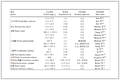
材料与方法1.样品采集:本次调查采集样品类型为金钗石斛鲜茎、丹霞石、苔藓和水源水4类,采样地点为贵州省赤水市主要的8个金钗石斛仿野生种植基地(表 1)。在每个种植基地内按照梅花点法设置5个子采样点进行石斛鲜茎、丹霞石和苔藓采样,将子采样点采集的同类型样品除去杂物现场混合后装入双层塑料袋内密封并标记样品信息,同时采集种植基地内水源水1份,装入聚乙烯扁桶中,按每升水样加入20 ml硝酸进行酸化,加盖密封。共采集32份样品,所有样品采集后带回实验室进行处理。
|
表 1 赤水市金钗石斛种植基地采样地点 Table 1 Sampling sites of Dendrobium nobile Lindl. in Chishui |
2.测量仪器:高纯锗γ能谱仪,型号为GEM-C7080-LB-C(美国ORTEC公司),对60Co的1 332 keV γ射线的能量分辨力为1.91 keV,相对探测效率为68%,24 h 50 ~ 2 000 keV的积分本底为2.08计数/s,数字多道为MFG-DESPEC-JR-2.0,谱分析软件为Gamma Vision 8.0。样品测量时放置在壁厚11.5 cm、内腔ϕ 27.5 cm × 41.7 cm的复合屏蔽铅室内。低本底α、β计数器型号为LB 4200-4(美国CANBERRA公司)。
3.标准源:高纯锗γ能谱仪能量刻度使用由中国计量科学研究院提供的标准点源152Eu(编号:DYEU 1803192)和60Co(编号:DYCO 1803191),效率刻度使用由中国计量科学研究院提供并校准的土壤监测效率校准源(证书编号:DLhd 2023-03347)和干粉基质效率标准源(证书编号:DLhd 2020-01561),均含有放射性核素238U、226Ra、232Th、40K、210Pb和137Cs。低本底α、β计数器效率刻度使用由中国计量科学研究院提供的水残渣中总α监测标准物质(编号:FMAM 220901)和水残渣中总β监测标准物质(编号:FMK 220901),分别含有放射性核素241Am和40K。所用标准源的基体材料、几何形状、密度与测量样品基本一致。
4.样品处理与测量
(1)γ能谱分析:参照《环境及生物样品中放射性核素的γ能谱分析方法》(GB/T 16145—2022)[7] 中提供的方法进行样品处理和测量。金钗石斛样品清洗、沥干表面水分后,放入托盘内置于烘箱中100℃烘干至恒重,经高速粉碎机粉碎过80目筛后装入型号PE 2000马林杯中,压样成型,称净重;丹霞石经破碎后与苔藓样品分别放入托盘内置于烘箱中100℃烘干至恒重,其中丹霞石使用球磨机进行研磨,苔藓直接使用高速粉碎机进行粉碎,过80目筛后装入外径ϕ 75 mm × 70 mm的圆柱形样品盒中,称净重。将称重后的样品进行密封、放置4周后再置于γ能谱仪上测量,测量时间为172 800 s。
(2) 总α、总β放射性测量:参照《生活饮用水标准检验方法第13部分:放射性指标》(GB/T 5750.13—2023)[8] 对赤水市金钗石斛种植基地水源水进行样品处理与测量,取2 L水样加热浓缩至50 ml,转移到已称重的坩埚内,加入1 ml硫酸,缓慢加热蒸干、灼烧,冷却后称取160 mg的残渣粉末,研细,均匀铺在直径为45 mm的测量盘内,置于低本底α、β计数器上测量,每次测量时间为1 000 min。
5.结果计算:参照GB/T 16145—2022[7] 全能峰效率曲线法计算金钗石斛、丹霞石和苔藓中核素活度浓度及探测下限。参照GB/T 5750.13—2023[8] 厚源法和低本底总β测量法计算水源水中总α和总β放射性活度浓度及探测下限。
6.质量控制:实验人员定期参加放射卫生检测技术培训,严格掌握样品处理和测量的技术要求。测量仪器定期送计量检定部门检定,保证设备的技术指标满足测量要求,并定期对测量仪器进行稳定性、能量刻度等核查。每年参加由中国疾病预防控制中心辐射防护与核安全医学所组织的全国放射性核素γ能谱分析和总α、总β放射性测量能力比对考核,结果均合格。
7.统计学处理:使用SPSS 31.0软件进行分析,对数据进行正态性检验,符合正态分布的数据用 ±s表示。对种植环境介质中主要放射性核素含量与其在金钗石斛中含量进行皮尔逊相关性分析。P<0.05为差异有统计学意义。
结果1. 金钗石斛和种植环境介质中主要放射性核素含量:金钗石斛、丹霞石和苔藓各8份样品中 238U含量均低于探测下限。苔藓中232Th、226Ra、210Pb、137Cs含量均高于其在金钗石斛中的含量,40K含量低于其在金钗石斛中的含量。丹霞石中232Th、226Ra、40K、137Cs含量均高于其在金钗石斛的含量,210Pb含量低于其在金钗石斛的含量,见表 2。
|
|
表 2 金钗石斛和种植环境介质中主要放射性核素含量[Bq/kg干重,x±s(范围)] Table 2 Activity concentrations of major radionuclides in Dendrobium nobile Lindl. and in its cultivation matrices[Bq/kg dry weight, x±s(range)] |
2.金钗石斛种植基地水源水总α、总β放射性水平:8个金钗石斛种植基地水源水总α放射性活度浓度范围为0.005 ~ 0.149 Bq/L,平均结果为(0.032 ± 0.029)Bq/L,总β放射性活度浓度范围为0.023 ~ 0.096 Bq/L,平均结果为(0.046 ± 0.020)Bq/L。
3.环境介质中主要放射性核素含量与其在金钗石斛中含量的相关性分析:丹霞石和苔藓中232Th、226Ra、40K、210Pb、137Cs含量与其在金钗石斛中含量的相关性分析结果如表 3所示。丹霞石中232Th、226Ra、40K、137Cs和210Pb含量,以及苔藓中232Th、226Ra、40K和137Cs含量,与其在金钗石斛中的含量无明显相关性(P > 0.05)。苔藓中210Pb含量与其在金钗石斛中含量具有正相关性(r=0.90,P < 0.05)。
|
|
表 3 环境介质中主要放射性核素含量与其在金钗石斛中含量的皮尔逊分析结果 Table 3 Pearson correlation analysis of activity concentrations in Dendrobium nobile Lindl. and its cultivation matrices |
讨论
金钗石斛在贵州省赤水市有着较长的食用历史和普遍的食用习惯。目前,其叶和花已在贵州制定并发布食品安全地方标准,作为特色食品进行管理,但其茎的食品安全标准尚未发布,本研究可为金钗石斛食用安全评估及相关标准的制订与修订提供基础数据。本次调查的金钗石斛中放射性核素232Th、226Ra、40K和137Cs含量略高于我国西南地区的蔬菜、粮食等的调查结果[9-11],这可能与其生长周期长于蔬菜、粮食等作物有关,但上述核素含量均远低于《食品中放射性物质限制浓度标准》(GB 14882—1994)[12] 中规定的放射性核素限制浓度。其中,210Pb含量较高,远高于我国食品中210Pb调查结果[13](平均值为0.258 Bq/kg),也高于我国部分地区茶叶中210Pb含量[14-15] (平均值为24.0 Bq/kg),与福建省烟叶中210Pb含量[15](130.0 Bq/kg)较为接近。
丹霞石、苔藓和水源水与金钗石斛的生长密切相关,丹霞石经风化可提供部分矿质元素,苔藓能维持岩面持水性以及截留雨水、尘土等,为金钗石斛生长创造了环境条件[3]。本次调查的丹霞石和水源水中放射性水平分别处于贵州省土壤放射性核素含量范围及贵阳市集中式供水水源水总α、总β放射性活度浓度范围[16-17] 内,属于正常的天然放射性本底水平。苔藓中210Pb含量远高于其在丹霞石和金钗石斛中含量,且与金钗石斛中210Pb含量呈强正相关关系(r = 0.90,P < 0.05)。210Pb是天然放射性铀系中由222Rn经一系列衰变生成,金钗石斛中210Pb可能来源于种植基地近地面形成的含210Pb放射性气溶胶沉降于苔藓中被金钗石斛吸收[18],需进一步调查种植基地气溶胶中210Pb放射性水平,分析210Pb在各环境介质中的含量分布情况,以明确其来源及富集作用。
本次调查采取随机抽样,由于研究条件等原因的限制,调查的样品数量有限,得到的数据不够多,另外,较难获取足量的苔藓和土壤样品,将苔藓和其根部少量土壤作为一个整体环境介质样品进行了分析,在今后条件宽裕情况下会继续充实实验数据。
利益冲突 无
作者贡献声明 吴正强负责样品采集、数据分析和论文撰写;王家乐、孟秀柔负责样品处理和测量;杨忠负责调查方案的设定;田祝娟、刘利亚指导论文撰写和修改;吴玉田负责资料收集整理和协助采样
| [1] |
王琳, 叶庆生, 刘伟. 金钗石斛研究概况(综述)[J]. 亚热带植物科学, 2004, 33(2): 73-76. Wang L, Ye QS, Liu W. A review of advances in research on Dendrobium nobile[J]. Subtrop Plant Sci, 2004, 33(2): 73-76. DOI:10.3969/j.issn.1009-7791.2004.02.022 |
| [2] |
何勇. 赤水市: 金钗石斛产业书写丹霞石上的生命传奇[J]. 理论与当代, 2020, 430(2): 52-52. He Y. Chishui city: The Dendrobium nobile industry: a legend of life cultivated on Danxia stones[J]. Theory Contemp, 2020, 430(2): 52-52. |
| [3] |
李明松, 李金玲, 赵致, 等. 附丹霞石栽培金钗石斛矿质元素吸收与分配研究[J]. 江苏农业科学, 2023, 51(16): 119-126. Li MS, Li JL, Zhao Z, et al. Study on the absorption and distribution of mineral elements in Dendrobium nobile cultivated on Danxia stones[J]. Jiangsu Agric Sci, 2023, 51(16): 119-126. DOI:10.15889/j.issn.1002-1302.2023.16.017 |
| [4] |
谭道鹏, 卢叶, 刘桂岚, 等. 贵州铁皮石斛、金钗石斛中农药残留、重金属及有害元素含量分析[J]. 遵义医科大学学报, 2022, 45(1): 111-117. Tan DP, Lu Y, Liu GL, et al. Analysis of pesticide residues, heavy metals and harmful elements in Dendrobium officinale and D.nobile in Guizhou[J]. J Zunyi Med Univ, 2022, 45(1): 111-117. DOI:10.14169/j.cnki.zunyixuebao.2022.0015 |
| [5] |
倪张林, 袁新跃, 叶彩芬, 等. 不同栽培模式下铁皮石斛中重金属含量及健康风险评估[J]. 江西农业大学学报, 2017, 39(4): 686-690. Ni ZL, Yuan XY, Ye CF, et al. Concentrations of heavy metals in Dendrobium officinal in different cultivation modes and health risk assessment[J]. Acta Agric Univ Jiangxiensis, 2017, 39(4): 686-690. DOI:10.13836/j.jjau.2017089 |
| [6] |
United Nations Scientific Committee on the Effects of Atomic Radiation. UNSCEAR 2008 report. Sources and effects of ionizing radiation[R]. New York: UNSCEAR, 2010.
|
| [7] |
国家市场监督管理总局, 国家标准化管理委员会. GB/T 16145—2022环境及生物样品中放射性核素的γ能谱分析方法[S]. 北京: 中国标准出版社, 2022. State Administration for Market Regulation, National Standardization Administration. GB/T 16145-2022 Gamma-ray spectrometry method for the determination of radionuclides in environmental and biological samples[S]. Beijing: Standards Press of China, 2022. |
| [8] |
国家市场监督管理总局, 国家标准化管理委员会. GB/T 5750.13—2023生活饮用水标准检验方法第13部分: 放射性指标[S]. 北京: 中国标准出版社, 2023. State Administration for Market Regulation, National Standardization Administration. GB/T 5750.13-2023 Standard examination methods for drinking water—Part 13: Radiological indies[S]. Beijing: Standards Press of China, 2023. |
| [9] |
黄强, 李炜, 李奎. 重庆市食品放射性核素含量调查结果分析[J]. 中国辐射卫生, 2023, 32(4): 433-437. Huang Q, Li W, Li K. An analysis of the investigation results of radionuclide content in food in Chongqing, China[J]. Chin J Radiol Health, 2023, 32(4): 433-437. DOI:10.13491/j.issn.1004-714X.2023.04.013 |
| [10] |
朱银莹, 牟胜, 樊芳, 等. 云南省部分地区大米和玉米放射性核素水平调查[J]. 中华放射医学与防护杂志, 2020, 40(7): 536-539. Zhu YY, Mou S, Fan F, et al. Radionuclide concentration of rice and corn in some areas of Yunnan province[J]. Chin J Radiol Med Prot, 2020, 40(7): 536-539. DOI:10.3760/cma.j.issn.0254-5098.2020.07.008 |
| [11] |
拓飞, 徐翠华, 张京, 等. 云南芒市地区野生食用蘑菇中137Cs、40K含量及所致居民剂量估算[J]. 中华放射医学与防护杂志, 2014, 34(8): 621-625. Tuo F, Xu CH, Zhang J, et al. Measurement of activity concentrations for 137Cs and 40K in edible wild mushrooms collected from Mangshi, Yunnan province and evaluation of dose to adults[J]. Chin J Radiol Med Prot, 2014, 34(8): 621-625. DOI:10.3760/cma.j.issn.0254-5098.2014.08.015 |
| [12] |
中华人民共和国卫生部. GB 14882—1994食品中放射性物质限制浓度标准[S]. 北京: 中国标准出版社, 1994. Ministry of Health of the People's Republic of China. GB 14882-1994 Limited concentrations of radioactive materials in foods[S]. Beijing: Standards Press of China, 1994. |
| [13] |
刘玉兰, 徐宁, 胡爱英. 我国食品和水中天然放射性核素水平的调查[J]. 中华放射医学与防护杂志, 1988, 8(S1): 1-14. Liu YL, Xu N, Hu AY. Investigation of natural radionuclides in foods and waters in China[J]. Chin J Radiol Med Prot, 1988, 8(S1): 1-14. |
| [14] |
颜家全. 湖南省主要食品中210Pb和210Po含量的调查[J]. 辐射防护, 1991, 11(3): 3. |
| [15] |
陈秀云, 翁德通, 杨孝桐. 福建食品和水中210Pb与210Po放射性含量及其所致居民内照射剂量估算[J]. 中国辐射卫生, 1996(4): 214-215. Chen XY, Weng DT, Yang XT. Content of 210Pb and 210Po in Foods and Water in Fujian Province and Assessment of Related Dose to Population[J]. Chin J Radiol Health, 1996(4): 214-15. DOI:10.13491/j.cnki.issn.1004-714x.199604011 |
| [16] |
陈志岳, 郑章华, 沈巧丽, 等. 贵州省土壤中天然放射性核素含量调查[J]. 辐射防护, 1986, 6(4): 296-298. |
| [17] |
吴正强, 田祝娟, 杨忠, 等. 2018—2021年贵阳市集中式供水生活饮用水总α和总β放射性调查[J]. 环境与健康杂志, 2023, 40(2): 177-178. Wu ZQ, Tian ZJ, Yang Z, et al. Analysis of gross α and gross β radioactivity results of centralized drinking water supply in Guiyang city, 2018-2021[J]. J Environ Health, 2023, 40(2): 177-178. DOI:10.16241/j.cnki.1001-5914.2023.02.017 |
| [18] |
姚帅墨, 拓飞, 张庆, 等. 北京春季室外空气中210Pb放射性水平测量与分析[J]. 中华放射医学与防护杂志, 2017, 37(4): 286-289. Yao SM, Tuo F, Zhang Q, et al. Measurement and analysis of 210Pb radioactivity level in outdoor air during spring in Beijing[J]. Chin J Radiol Med Prot, 2017, 37(4): 286-289. DOI:10.3760/cma.j.issn.0254-5098.2017.04.011 |