 2025, Vol. 45


2. 解放军总医院研究生院, 北京 100853
2. Graduate School of Chinese PLA General Hospital, Beijing 100853, China
异基因造血干细胞移植(allogeneic hematopoietic stem cell transplantation,allo-HSCT)是治愈高危恶性血液病最有效的方法。移植前预处理的方式和强度与移植预后息息相关。全身照射(total body irradiation,TBI)或全骨髓照射(total marrow irradiation,TMI)作为allo-HSCT预处理方案之一,相较于全化疗方案,有全身均匀分布、减少化学药物的暴露、清除骨髓中的耐药肿瘤细胞及隐匿病灶如中枢及睾丸中的肿瘤细胞等优势[1-2],但仍存在急性或晚期不良反应例如恶心、呕吐、间质性肺炎、神经系统毒性及继发肿瘤等[3-4]。在接受人白细胞抗原(human leucocyte antigen,HLA)同胞全相合或非亲缘全相合allo-HSCT的急性髓系白血病(acute myeloid leukemia,AML)患者中,TBI预处理和全化疗预处理方案具有相似的移植预后[5-7]。在单倍型造血干细胞移植(haploidentical hematopoietic stem cell transplantation, Haplo-HSCT)中,白消安联合环磷酰胺(Bu/Cy)预处理方案在高危恶性血液病中有较高的复发率及移植相关死亡率,移植无法达到令人满意的生存结局,促使含照射预处理方案在单倍型移植中进行开展和探索。AML和骨髓增生异常综合征(myelodysplastic syndrome,MDS)在血液恶性肿瘤中发病率最高[8]。既往有限的回顾性研究提示,在行单倍型移植的AML或MDS患者中,TBI为基础的预处理方案有利于疾病的控制及减少复发,但可能增加移植物抗宿主病(graft versus host disease, GVHD)风险[9-10]。上述研究观察随访时间较短,对复发难治性患者尚无定论,缺乏长期随访相关数据。
本回顾性研究旨在比较含照射的预处理方案和化疗预处理方案在Haplo-HSCT治疗高危AML/MDS的长期疗效和安全性。评估在行单倍型移植的高危AML/MDS患者中,采用照射作为预处理方案,相较于全化疗,是否能有效减少疾病的复发,延长患者的生存期。
资料与方法1. 一般资料:收集解放军总医院第五医学中心2015年1月至2019年12月行Haplo-HSCT治疗的共63例高危AML/MDS患者的临床资料。高危AML定义为包含以下情况之一:初诊时外周血白细胞计数>109/L;有髓外或中枢神经系统浸润;继发于MDS、骨髓增殖性疾病(MPD)或先前有放化疗病史;有高危染色体核型或突变,即-5/del(5q)、-7/del(7q)、t(6;9)、t(9;22)、t(8;21)或inv(3)、t(v; 11q23.3)/KMT2A-rearranged或复杂核型(异常核型≥ 3个);TP53突变;原发难治或复发难治;为第2次或以上达完全缓解(≥CR2);高危MDS定义为世界卫生组织(WHO)2016分型诊断标准中为MDS-EB1或MDS-EB2,或者修订国际预后积分系统(IPSS-R)> 3.5分的患者。根据预处理方案不同分为照射组和化疗组。照射组17例,中位年龄33(10~54)岁,男9例(占52.94%),女8例(占47.06%);化疗组46例,中位年龄41(13~64)岁,男25例(占54.35%),女21例(占45.65%)。该研究获解放军总医院第五医学中心医学伦理委员会批准(审批号:KY-2024-11-181-1),所有患者资料采集均免除知情同意。
2.预处理方案:照射组采用TBI或TMI联合环磷酰胺(TBI/Cy)即TBI 5 Gy×2 d,Cy 60 mg/(kg·d)×2 d;TMI 4 Gy×3 d,Cy 60 mg/(kg·d)×2 d。化疗组采用白消安联合环磷酰胺(Bu/Cy)即BU 3.2 mg/(kg·d)×4 d或3 d,Cy 60 mg/(kg·d)×2 d;氟达拉滨联合白消安(Flu/Bu):Flu 30 mg/m2×5 d或40 mg/m2×4 d,Bu 3.2 mg/(kg·d)×4 d或3 d。
3.疗效评价和随访:中性粒细胞重建定义为移植后连续3 d中的第1次中性粒细胞数大于0.5×10⁹/L的时间,血小板重建定义为移植后在不依赖血小板输注情况下连续7 d血小板计数> 20×109/L。急性GVHD(acute GVHD,aGVHD)依据西奈山aGVHD国际联盟(The Mount Sinai Acute GVHD International Consortium,MAGIC)进行分级,记录100 d内发生aGVHD情况。慢性GVHD(chronic GVHD,cGVHD)根据美国国立卫生研究院(NIH)2014严重程度进行诊断分级。EB病毒(Epstein\|Barr virus, EBV)血症/巨细包病毒(Cytomegalovirus, CMV)血症定义为血液中EBV或CMV核酸载量>1 000拷贝/mL。非复发死亡(non relapse mortality,NRM)为造血干细胞移植后无复发证据情况下任何原因所导致的死亡。无病生存期(disease-free survival,DFS)为移植后复发或因其他原因导致死亡的时间,或处于完全缓解状态患者随访终止时间。无慢性GVHD无复发生存期(cGVHD-free relapse-free survival,GRFS)为造血干细胞移植后需要全身免疫抑制治疗的cGVHD、疾病复发或移植后任何原因死亡。总生存期(overall survival,OS)为移植后至因任何原因所致死亡的时间或至观测截止时间。
4.统计学处理:采用SPSS26.0及R4.3.3软件进行统计学分析。所有人口学信息、临床及实验室特征被分为两组(照射组和化疗组),失访数据采用末次观测值结转法填补。连续型变量符合正态分布的数据采用t检验,当数据不满足正态分布或方差不齐时则采用U检验,分类变量采用Fisher′s确切概率法。随访时间采用反向生存曲线(Reverse kaplan-meier,Reverse KM)计算。OS、DFS和GRFS采用KM曲线进行生存分析并采用log-rank检验。巨细胞病毒(CMV)血症、EB病毒(EBV)血症、GVHD、复发、NRM采用竞争风险模型计算累积发生率,并采用Fine-Gray′s检验。GVHD采用部分分布风险回归模型进行多因素分析,OS、DFS、GRFS采用Cox比例风险模型进行多因素分析。P < 0.05为差异有统计学意义。
结果1.临床资料:所有患者的中位随访时间为76.4个月,照射组和化疗组的中位随访时间分别为78.5和73.3个月。在基本临床特征上,照射组包括2例巴利昔单抗作为GVHD预防方案患者,并且移植前达第1次完全缓解患者占比更低(t=8.21, P=0.013),而化疗组受者中位年龄为41(33~64)岁高于照射组的33(10~54)岁,(t=2.18,P=0.033)。两组在性别、AML及MDS占比、移植前状态、移植物来源、干细胞输注数量等差异无统计学意义(P>0.05)。
2.Haplo-HSCT后植入情况:照射组17例患者全部顺利植入,植入成功率为100%,中性粒细胞植活的中位时间为14.0(11~32)d,血小板植活的中位时间为15.0(10~28)d。化疗组有两例患者在植入前死亡,死亡原因为脑出血和感染,两例患者植入失败,植入成功率为95.5%,中性粒细胞植活的中位时间为14.5(10~19)d,血小板植活的中位时间为13.0(10~60)d。两组造血重建比较差异无统计学意义(P>0.05)。
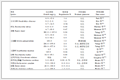
3.GVHD发生情况:如表 1所示,照射组和化疗组100 d Ⅱ~Ⅳ级aGVHD的累积发生率为29.4% vs. 21.7%,Ⅲ~Ⅳ级aGVHD的累积发生率为23.5% vs. 13.0%,生存曲线示照射组Ⅱ~Ⅳ级和Ⅲ~Ⅳ级aGVHD累积发生率的生存曲线高于化疗组,但两组差异无统计学意义(P>0.05)。照射组和化疗组总体cGVHD及重度cGVHD累积发生率相近,分别为35.3% vs. 39.1%、11.8% vs. 8.7%, 差异亦无统计学意义(P>0.05)。
|
表 1 两组高危AML/MDS患者GVHD发生率 Table 1 Incidence of GVHD in two groups of high-risk AML/MDS patients |
4.病毒感染情况:对两组患者的巨细胞病毒(CMV)血症及EB病毒(EBV)血症情况进行分析。移植后1年内照射组共10例患者发生CMV血症,10例患者发生EBV血症,累积发生率均为58.8%。化疗组共32例患者发生CMV血症,共20例患者发生EBV血症,累积发生率分别为69.6%、43.5%,两组比较差异均无统计学意义(P>0.05)。
5.复发率及非复发死亡率:照射组和化疗组的5年复发率(relapse rate, RR)分别为20.2%和28.4%,差异无统计学意义(P>0.05);照射组NRM累积发生率(5.9%)数值要低于化疗组(23.9%),竞争风险曲线趋势要好于化疗组,但差异无统计学意义(P>0.05),照射预处理与化疗预处理患者复发和非复发死亡竞争风险生存分析列于表 2。
|
|
表 2 两组高危AML/MDS患者5年复发、非复发死亡及生存分析 Table 2 Five-year relapse, non-relapse mortality, and survival outcomes of two groups of high-risk AML/MDS patients |
6.生存分析:移植后,照射组和化疗组的5年OS、DFS、GRFS分别为81.1%、54.4%和73.9%及47.7%,58.8%和43.5%,两组生存情况差异均无统计学意义(P>0.05),但照射组的生存曲线趋势要优于化疗组,见图 1。将GVHD预防方案、预处理方案、患者年龄、移植前疾病状态等纳入多因素分析,未发现照射预处理是影响生存预后的独立因素(表 3)。

|
图 1 照射预处理与化疗预处理方式患者的生存曲线 A. 总生存(OS);B. 无病生存(DFS);C. 无cGVHD无复发生存(GRFS) Figure 1 Survival curves of patients undergoing irradiation/ chemotherapy conditioning A. Overall survival (OS); B. Disease-free survival (DFS); C. cGVHD-free relapse-free survival (GRFS) |
|
|
表 3 两组高危AML/MDS患者生存情况的多因素分析 Table 3 Multivariate analysis of the survival of two groups of high-risk AML/MDS patients |
7.死因分析:纳入研究的63例患者中共24例发生死亡,其中照射组3例,化疗组21例。无论照射组还是化疗组,原发恶性血液病复发是主要死亡原因,其次死亡原因为感染(表 4)。
|
|
表 4 照射预处理与化疗预处理方案高危AML/MDS患者死亡原因分析 Table 4 Causes of death in patients undergoing irradiation/ chemotherapy conditioning |
讨论
Allo-HSCT是高危AML及MDS最有效的治疗方法。目前常用的经典清髓性预处理方法主要包含两大类:含照射方案(如TBI联合环磷酰胺)及全化疗方案(如白消安联合环磷酰胺或白消安联合氟达拉滨)。既往多项研究显示,TBI方案和全化疗方案在HLA全相合亲缘和非亲缘异基因造血干移植中,总体生存和无病生存结果不一致,存在一定的争议,但多数前瞻性及回顾性研究结果提示含TBI的预处理方案具有更高的总生存率及更低的复发率[11-16]。随着GVHD预防方案的改进,如T细胞体内清除的PTCy方案及ATG方案的使用,HLA屏障被打破,单倍型移植与非血缘HLA全相合移植有相似的生存预后[17-20]。在缺乏HLA全相合供者的恶性血液病患者中,单倍型造血干细胞成为移植物来源之一,因其可及性强及后期可再获取等优势,在近年的异基因移植占比中逐年升高。2022年,我国的Haplo-HSCT的占比已达到65%[21]。Raiola等[22]的一项研究结果表明,含照射的预处理方案在Haplo\|HSCT中可以有效植入并诱导免疫耐受。该研究促进了含照射的清髓性预处理方案在单倍型移植中应用。迄今,基于照射的清髓性预处理方案在单倍型造血干细胞移植治疗高危AML/MDS的相关临床研究较少,尤其是缺乏真实世界长期随访研究[26-29]。
由于HLA不相合程度大,移植排斥发生率高,植入是单倍型造血干细胞移植面临的重要问题之一。既往研究表明含TBI预处理方案能够有效清除淋巴细胞、减少移植排斥、提供植入的物理空间,并且具有更好的宿主免疫抑制[23-25]。本研究结果显示,以照射为基础的清髓性预处理组植入率100%,而化疗组有2例患者植入失败,植入成功率为95.5%。照射组和化疗组的中性粒细胞植入的造血重建时间相似。
急、慢性GVHD是移植后主要并发症之一,也是影响移植预后的主要因素之一。在选择移植前预处理方案时,如何减少GVHD的发生也是重要的考量问题。本研究结果显示照射组aGVHD的发生趋势相对高一些,但差异无统计学意义,两组cGVHD发生率相当。Dholaria等[28]的回顾性研究表明,在行单倍型移植的AML患者中以TBI为基础的预处理方案与全化疗方案相比,100 d Ⅱ~Ⅳ及Ⅲ~Ⅳ aGVHD的累积发生率差异无统计学意义,其中TBI组100 d Ⅱ~Ⅳ级aGVHD发生率为26.3%,与本研究结果一致。而在cGVHD方面,该研究TBI组的2年总cGVHD发生率显著高于化疗组(42% vs. 27%,P < 0.01)。本研究的cGVHD发生率相当,结果与之存在差异,这可能与两个研究选择的GVHD预防方案不同有关。GVHD预防方案是影响GVHD发生率的最主要因素之一,Dholaria等[28]的研究中采用了欧美单倍型移植常用的以PTCy为骨架GVHD预防方案,而本研究中,大部分采用了我国常用的以ATG为骨架的GVHD预防方案,少部分采用了以PTCy联合CCR5拮抗剂为骨架GVHD预防方案。两种GVHD预防方案在两组中占比无差异,需要扩大样本量或进行前瞻性随机对照进一步证实。
最大限度地降低肿瘤负荷和恶性疾病复发率是选择预处理方案的重要影响因素。在既往HLA相合供者移植的相关研究中,含照射预处理方案倾向于有更低的复发率。本研究中,照射组有更低的复发率和非复发死亡率,但差异无统计学意义。Fu等[29]的一项研究中,照射组与化疗组的2年复发率为26.5% vs. 32.3%,1年移植相关死亡率为12.6% vs. 16.2%,照射组具有更低的复发趋势及非复发死亡趋势,差异无统计学意义。本研究结果与此一致,该项研究涉单倍型造血干细胞移植治疗包括急性淋巴细胞白血病在内的多种恶性血液病。
造血干细胞移植后的长期生存率和生存质量与预处理方案密切相关。本研究结果显示照射组和化疗组的5年OS、DFS和GRFS等生存情况差异无统计学意义,但照射组具有更好的OS、DFS及GRFS趋势。在Fu等[29]的研究中,TBI组及化疗组2年OS、DFS分别为60.0% vs. 57.0%和57.9% vs. 56.6%,两组结果相似。而在高危患者人群中,TBI组及化疗组2年OS、DFS分别为52.5% vs. 41.1%和49.5% vs. 39.9%,差异虽然无统计学意义,但TBI组更具优势,本研究结果与之一致。因此,在高危AML/MDS患者中,含照射方案具有更好的生存趋势。
本回顾性观察研究存在一定的局限性,病例数较少,为真实世界病历数据,混杂因素较多。研究中包含2例全骨髓照射患者,该方案作为改良照射方案能够保留照射的优势而限制对身体其余部位例如性腺、心脏等的损伤,目前尚缺乏TBI和TMI疗效的直接对比。
综上,本研究提示在单倍型造血干细胞移植治疗高危髓系恶性肿瘤如AML/MDS患者中,以照射为主的清髓性预处理方案相较于全化疗方案RR和NRM有降低、而DFS和OS有增高的趋势,需要更大样本或者前瞻性的随机对照研究进一步证实。
利益冲突 无
作者贡献声明 刘姝宏负责数据整理、统计学分析及论文撰写;孙一德协助数据整理和分析;王军、扈江伟、李欲航、苏永锋、刘娜、乔卓青、胡亮钉、徐磊提供技术和材料支持;宁红梅指导研究设计和论文修改
| [1] |
Luo C, Wu G, Huang X, et al. Myeloablative conditioning regimens in adult patients with acute myeloid leukemia undergoing allogeneic hematopoietic stem cell transplantation in complete remission: a systematic review and network meta-analysis[J]. Bone Marrow Transplant, 2023, 58(2): 175-185. DOI:10.1038/s41409-022-01865-6 |
| [2] |
房彤, 任健, 陈力, 等. 造血干细胞移植前全身分次照射的临床研究[J]. 中华放射医学与防护杂志, 2007, 27(1): 70-72. Fang T, Ren J, Chen L, et al. Study on the clinical effect of fractionated total body irradiation before hematopoietic stem cell transplantation[J]. Chin J Radiol Med Prot, 2007, 27(1): 70-72. DOI:10.3760/cma.j.issn.0254-5098.2007.01.026 |
| [3] |
Paix A, Antoni D, Waissi W, et al. Total body irradiation in allogeneic bone marrow transplantation conditioning regimens: a review[J]. Crit Rev Oncol Hematol, 2018, 123: 138-148. DOI:10.1016/j.critrevonc.2018.01.011 |
| [4] |
Dogliotti I, Levis M, Martin A, et al. Maintain efficacy and spare toxicity: Traditional and new radiation-based conditioning regimens in hematopoietic stem cell transplantation[J]. Cancers (Basel), 2024, 16(5): 865. DOI:10.3390/cancers16050865 |
| [5] |
Litzow MR, Pérez WS, Klein JP, et al. Comparison of outcome following allogeneic bone marrow transplantation with cyclophosphamide-total body irradiation versus busulphan-cyclophosphamide conditioning regimens for acute myelogenous leukaemia in first remission[J]. Br J Haematol, 2002, 119(4): 1115-1124. DOI:10.1046/j.1365-2141.2002.03973.x |
| [6] |
Nagler A, Rocha V, Labopin M, et al. Allogeneic hematopoietic stem-cell transplantation for acute myeloid leukemia in remission: comparison of intravenous busulfan plus cyclophosphamide (Cy) versus total-body irradiation plus Cy as conditioning regimen--a report from the acute leukemia working party of the European group for blood and marrow transplantation[J]. J Clin Oncol, 2013, 31(28): 3549-3556. DOI:10.1200/JCO.2013.48.8114 |
| [7] |
Eder S, Labopin M, Arcese W, et al. Thiotepa-based versus total body irradiation-based myeloablative conditioning prior to allogeneic stem cell transplantation for acute myeloid leukaemia in first complete remission: a retrospective analysis from the Acute Leukemia Working Party of the European Group for Blood and Marrow Transplantation[J]. Eur J Haematol, 2016, 96(1): 90-97. DOI:10.1111/ejh.12553 |
| [8] |
Pogosova-Agadjanyan EL, Moseley A, Othus M, et al. AML risk stratification models utilizing ELN-2017 guidelines and additional prognostic factors: a SWOG report[J]. Biomark Res, 2020, 8: 29. DOI:10.1186/s40364-020-00208-1 |
| [9] |
Jung J, Lee H, Suh YG, et al. Current use of total body irradiation in haploidentical allogeneic hematopoietic stem cell transplantation[J]. J Korean Med Sci, 2021, 36(8): e55. DOI:10.3346/jkms.2021.36.e55 |
| [10] |
Malard F, Holler E, Sandmaier BM, et al. Acute graft-versus-host disease[J]. Nat Rev Dis Primers, 2023, 9(1): 27. DOI:10.1038/s41572-023-00438-1 |
| [11] |
Bug G, Labopin M, Niittyvuopio R, et al. Fludarabine/TBI 8 Gy versus fludarabine/treosulfan conditioning in patients with AML in first complete remission: a study from the Acute Leukemia Working Party of the EBMT[J]. Bone Marrow Transplant, 2023, 58(6): 710-716. DOI:10.1038/s41409-023-01965-x |
| [12] |
Morsink LM, Bezerra ED, Othus M, et al. Comparative analysis of total body irradiation (TBI)-based and non-TBI-based myeloablative conditioning for acute myeloid leukemia in remission with or without measurable residual disease[J]. Leukemia, 2020, 34(6): 1701-1705. DOI:10.1038/s41375-019-0671-x |
| [13] |
Socié G, Clift RA, Blaise D, et al. Busulfan plus cyclophosphamide compared with total-body irradiation plus cyclophosphamide before marrow transplantation for myeloid leukemia: long-term follow-up of 4 randomized studies[J]. Blood, 2001, 98(13): 3569-3574. DOI:10.1182/blood.v98.13.3569 |
| [14] |
Giebel S, Labopin M, Sobczyk-Kruszelnicka M, et al. Total body irradiation + fludarabine compared to busulfan + fludarabine as "reduced-toxicity conditioning" for patients with acute myeloid leukemia treated with allogeneic hematopoietic cell transplantation in first complete remission: a study by the Acute Leukemia Working Party of the EBMT[J]. Bone Marrow Transplant, 2021, 56(2): 481-491. DOI:10.1038/s41409-020-01050-7 |
| [15] |
Berning P, Kolloch L, Reicherts C, et al. Comparable outcomes for TBI-based versus treosulfan based conditioning prior to allogeneic hematopoietic stem cell transplantation in AML and MDS patients[J]. Bone Marrow Transplant, 2024, 59(8): 1097-1106. DOI:10.1038/s41409-024-02295-2 |
| [16] |
Bredeson C, LeRademacher J, Kato K, et al. Prospective cohort study comparing intravenous busulfan to total body irradiation in hematopoietic cell transplantation[J]. Blood, 2013, 122(24): 3871-3878. DOI:10.1182/blood-2013-08-519009 |
| [17] |
Bacigalupo A. Post-transplant cyclophosphamide: overcoming the HLA barrier to hematopoietic stem cell transplants[J]. Haematologica, 2022, 107(6): 1230-1231. DOI:10.3324/haematol.2022.281256 |
| [18] |
Wang Y, Liu QF, Xu LP, et al. Haploidentical vs identical-sibling transplant for AML in remission: a multicenter, prospective study[J]. Blood, 2015, 125(25): 3956-3962. DOI:10.1182/blood-2015-02-627786 |
| [19] |
Wang Y, Liu QF, Xu LP, et al. Haploidentical versus matched-sibling transplant in adults with philadelphia-negative high-risk acute lymphoblastic leukemia: a biologically phase Ⅲ randomized study[J]. Clin Cancer Res, 2016, 22(14): 3467-3476. DOI:10.1158/1078-0432.CCR-15-2335 |
| [20] |
Wang Y, Wang HX, Lai YR, et al. Haploidentical transplant for myelodysplastic syndrome: registry-based comparison with identical sibling transplant[J]. Leukemia, 2016, 30(10): 2055-2063. DOI:10.1038/leu.2016.110 |
| [21] |
Xu LP, Lu PH, Wu DP, et al. Hematopoietic stem cell transplantation activity in China 2022-2023. The proportions of peripheral blood for stem cell source continue to grow: a report from the Chinese Blood and Marrow Transplantation Registry Group[J]. Bone Marrow Transplant, 2024, 59(12): 1726-1734. DOI:10.1038/s41409-024-02419-8 |
| [22] |
Raiola AM, Dominietto A, Ghiso A, et al. Unmanipulated haploidentical bone marrow transplantation and posttransplantation cyclophosphamide for hematologic malignancies after myeloablative conditioning[J]. Biol Blood Marrow Transplant, 2013, 19(1): 117-122. DOI:10.1016/j.bbmt.2012.08.014 |
| [23] |
房彤, 高宏, 孙保锦, 等. 全身照射对造血干细胞移植后造血系统重建的临床分析[J]. 中华放射医学与防护杂志, 2008, 28(1): 66-68. Fang T, Gao H, Sun BJ, et al. Clinical analysis of hematopoiesis reconstruction after total body irradiation in hematopoietic stem cell transplantation[J]. Chin J Radiol Med Prot, 2008, 28(1): 66-68. DOI:10.3760/cma.j.issn.0254-5098.2008.01.022 |
| [24] |
Olsson RF, Logan BR, Chaudhury S, et al. Primary graft failure after myeloablative allogeneic hematopoietic cell transplantation for hematologic malignancies[J]. Leukemia, 2015, 29(8): 1754-1762. DOI:10.1038/leu.2015.75 |
| [25] |
Monaco F, Scott BL, Chauncey TR, et al. Total body irradiation dose escalation decreases risk of progression and graft rejection after hematopoietic cell transplantation for myelodysplastic syndromes or myeloproliferative neoplasms[J]. Haematologica, 2019, 104(6): 1221-1229. DOI:10.3324/haematol.2018.199398 |
| [26] |
Solomon SR, Solh M, Zhang X, et al. Fludarabine and total-body irradiation conditioning before ablative haploidentical transplantation: Long-term safety and efficacy[J]. Biol Blood Marrow Transplant, 2019, 25(11): 2211-2216. DOI:10.1016/j.bbmt.2019.06.017 |
| [27] |
Solomon SR, St Martin A, Shah NN, et al. Myeloablative vs reduced intensity T-cell-replete haploidentical transplantation for hematologic malignancy[J]. Blood Adv, 2019, 3(19): 2836-2844. DOI:10.1182/bloodadvances.2019000627 |
| [28] |
Dholaria B, Labopin M, Angelucci E, et al. Impact of total body irradiation- vs chemotherapy-based myeloablative conditioning on outcomes of haploidentical hematopoietic cell transplantation for acute myelogenous leukemia[J]. Am J Hematol, 2020, 95(10): 1200-1208. DOI:10.1002/ajh.25934 |
| [29] |
Fu H, Xu L, Liu D, et al. Total body irradiation and cyclophosphamide plus antithymocyte globulin regimen is well tolerated and promotes stable engraftment as a preparative regimen before T cell-replete haploidentical transplantation for acute leukemia[J]. Biol Blood Marrow Transplant, 2014, 20(8): 1176-1182. DOI:10.1016/j.bbmt.2014.04.012 |